|
Redefining leadership in ballast water treatment: inside PureBallast 3.0
4/3/2013 |
|
|
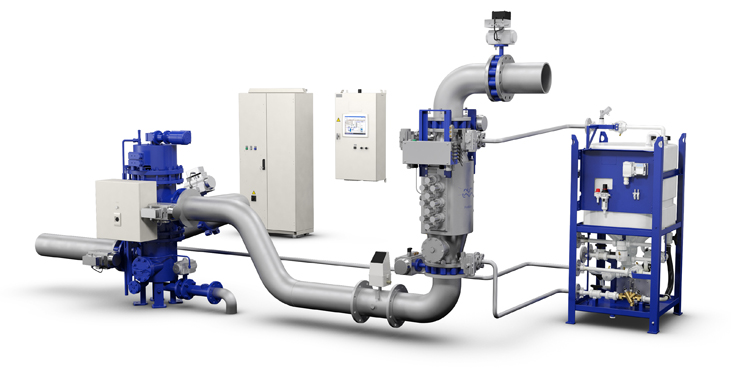
April marks the official unveiling of the third generation of Alfa Laval's chemical-free system for ballast water treatment. Less of an update than a sweeping redefinition of the system, PureBallast 3.0 re-establishes Alfa Laval as a groundbreaker in ballast water treatment.
PureBallast, which was developed in cooperation with Wallenius Water, was originally launched in 2006 as the world's very first commercially available ballast water treatment system. Since then it has matured considerably, arriving in an updated PureBallast 2.0 version with EX options in 2010. Already then there were improvements to its energy efficiency and its basic construction, but nothing to compare with the advances in PureBallast 3.0.
"This time we've completely rewritten the book when it comes to PureBallast," says Per Warg, the Alfa Laval Business Manager responsible for the system. "We've achieved space savings of 50%, energy savings of up to 60% and huge improvements in flexibility and flow capacity. But we've also learned a great deal that can be of impact for ballast water treatment in general."
Going back to the beginning
The development of PureBallast 3.0 began almost immediately after the release of its predecessor, with Alfa Laval returning to the drawing board in in early 2011. Jonas Alván, Product Development Manager for PureBallast, points out that this was really a new start for the system. "The original construction had been streamlined as much as was possible, which meant we were forced to think in new ways to move forward," he says.
That original construction had been decided at a time when no supplier knew what would be needed to pass the IMO tests. Not being a company to take risks with compliance, Alfa Laval had thus created PureBallast with a good margin of error in terms of biological efficiency. Now, drawing on real experience from around 100 PureBallast systems commissioned and hundreds more sold, it was possible to re-evaluate. So the development team set tough goals for the new system, especially when it came to energy efficiency.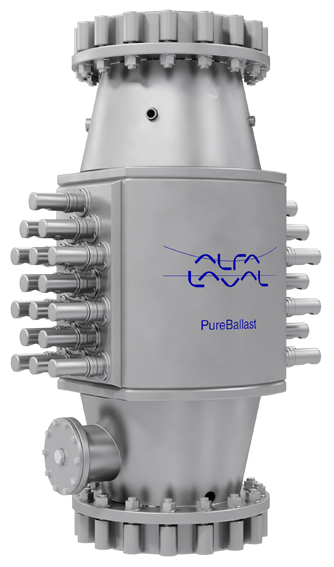
Identifying potential parameters
The key component in a UV-based system is its reactor, the chamber where UV treatment actually occurs. In standard UV treatment, organisms are eliminated directly or rendered unable to reproduce through damage to their DNA and biological structure. In PureBallast, the treatment process is enhanced by AOT (advanced oxidation technology), which creates free radicals that cause irreversible cell membrane damage. The AOT effect has a proven biological impact leading to better treatment performance and lower energy consumption.
In approaching a new PureBallast system, the development team asked itself one fundamental question: What factors determine the effectiveness of a UV-based reactor to be used with seawater at a high flow rate•
The latter part of that question was critical, according to Jonas Alván. "The UV treatment of seawater is a very different process from the UV treatment of drinking water on land," he explains. "In drinking water applications, which many ballast water treatment systems are adapted from, the process is continuous and targets mainly bacteria in pre-cleaned and well-regulated water. In ballast water treatment, the process is intermittent and involves a lot of standstill with saline water in the reactor. Plus the organisms targeted are hardier and more varied."
At sea, continuous treatment is not practically feasible. Neither is increasing residence time in the reactor, since ballasting and deballasting have to occur quickly. Adding stronger UV lamps or increasing the lamp number can increase biological efficiency, but only at the expense of energy efficiency. So the team was left with two main reactor parameters that could be adjusted: flow patterns and lamp placement.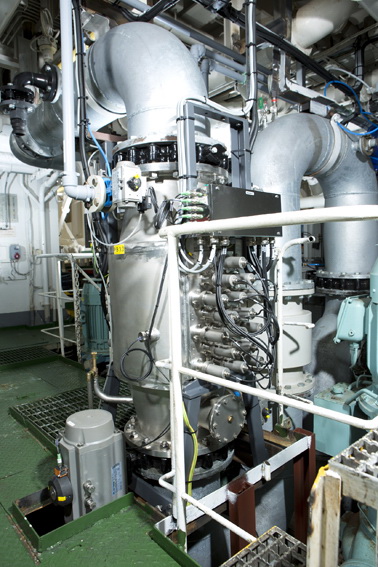
Developing the new reactor
"One of the things we were looking for was greater mixing, which would both increase the effect of the AOT and help to compensate for low UV transmittance," Alván says, referring to the distance UV light travels in water. "With more fluid mixing, the chance of an organism passing close to the UV lamps - and thereby the biological efficiency - increases."
Again, the difference between land-based and marine UV treatment was important. As Alván puts it, "Finding an acceptable balance of parameters is easier in a drinking water application, where clear and consistent water provides high UV transmittance. But the varying UV transmittance of ballast water, along with the need to minimize power consumption, makes it a more complex challenge to find an ideal reactor design."
That design was finally found with the help of a unique CFD (computational fluid dynamics) model, which was developed around a well-established model for standard UV treatment. In the new model, light sources were introduced into the equation, making it possible to see the UV dose for each of 50,000 theoretical particles (organisms) passing through the reactor.
"In our visualizations, we assigned each particle a colour according to the UV dose incurred," Alván explains. "By optimizing the reactor design for a uniform colour among exiting paths, we could ensure the most even UV dose possible. And that gave us the reactor design with the least possible energy consumption. The end result is startling."
Taking a hard look at CIP
Of course, the reactor was not the only focus of the PureBallast 3.0 development project. Another component re-evaluated was PureBallast's CIP (Cleaning-In-Place) unit, which cleans the UV lamp sleeves between treatments by circulating a non-toxic, low-pH fluid. In this case, however, the unit was left unchanged.
"A lot of suppliers leave out CIP as a way to save space and cost," says Alván. To evaluate the consequences of doing so, the team performed its own tests, allowing PureBallast to run for many cycles without performing CIP. "As it turns out, CIP was even more important than we expected," Alván says.
The reason is the build-up of calcium chlorides and metal ions on the UV lamp sleeves, which occurs not only in PureBallast, but in all UV treatment involving seawater. This build-up degrades the sleeves' UV transmittance, which greatly lowers the biological effect.
"We saw clear value in performing CIP to retain full equipment performance after ballasting or deballasting," Alván says. "Mechanical wipers remove calcium chlorides but not metal ions, and both wipers and manual cleaning will eventually cause performance-reducing scratches on the quartz glass. CIP is the most gentle and effective means available to keep performance at type-approved levels."
The finished system - a small wonder
The completed PureBallast 3.0 system, while based on the same treatment technology as its predecessors, is a remarkable leap forward in terms of its compactness, energy efficiency and flexibility. Most striking at a first glance is its size.
Where previous PureBallast reactors handled 250 m3/h each, individual PureBallast 3.0 reactors can handle either 300 m3/h or 1000 m3/h. Using the larger reactor, which is not much bigger than the original 250 m3/h version, the footprint of a 1000 m3/h system is literally cut in half. The bigger the system, the bigger the space savings.
"Needless to say, the new reactor capacities greatly reduce the footprint of larger systems," says Per Warg. "With one reactor doing the same job that four did before, PureBallast 3.0 is competitive across the entire flow range up to 6000 m3/h."
Energy savings of 30-60%
The size, however, is not the only thing that makes PureBallast 3.0 competitive. The new system is also as energy efficient as it is compact.
"The new 1000 m3/h reactors consume just 100 kW at full power, which is a minimum energy savings of 30% over previous versions," Warg says. "And when full power isn't needed, the energy savings can be as much as 60%."
Warg is referring to the new dimming function in PureBallast 3.0, which lowers the system's power consumption in clearer waters with good UV transmittance. In such conditions, less energy is needed to neutralize the organisms present. "PureBallast 3.0 has a dimming capacity of 50% and handles the dimming process automatically," says Warg. "The system will operate with some level of dimming in the majority of circumstances, providing up to 60% energy savings over previous versions in fully dimmed mode."
Installation flexibility and economy
For shipyards, the most appealing aspect of PureBallast 3.0 will not be its energy-efficient operation, but rather its high degree of flexibility and ease of installation - even when it comes to the highest flow rates. With the new reactor capacities, only one reactor will be needed per 1000 m3/h, which makes designing a system considerably simpler.
"When individual reactors can handle a greater amount of ballast water, there are fewer reactors and lamp drive cabinets to install," says Warg. "That means not only less installation time, but also easier and more economical installation, since it does away with a considerable amount of pipework."
When it comes to the lamp drive cabinets, there is an additional bit of flexibility. Whereas reactors and cabinets were attached in previous versions of PureBallast, the cabinets can now be placed anywhere up to 150 m away. "The free placement of lamp drive cabinets within 150 metres simplifies the design of EX systems, since the power supply is easy to place outside the hazardous zone," says Warg. "But it's of benefit to everyone, since it can save space in the engine room where it's needed most."
Leadership redefined
Warg and Alván are visibly proud of the new PureBallast 3.0, and certainly not without reason. Its capabilities and features place the new system firmly at the cutting edge of ballast water treatment.
"Alfa Laval has always been at the forefront of ballast water treatment, but PureBallast 3.0 truly redefines that leadership," says Warg. "We're looking not just at a new generation of the system, but rather at a whole new standard that lives up to the tougher demands raised by today's customers." His colleague Alván agrees, concluding, "Where size, economy and energy efficiency are important, I've no doubt that customers will find what they're looking for in PureBallast 3.0."
To learn more about PureBallast 3.0 and Alfa Laval's approach to ballast water treatment, visit www.alfalaval.com/pureballast3 |
|
|
|
|
|