|
Continental Supplies World's First Turbocharger with Aluminum Turbine Housing in Cars
7/18/2014 |
|
|
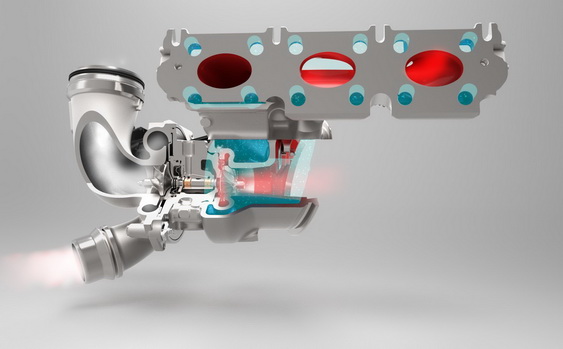
Milestone: Continental's turbocharger with water-cooled aluminum turbine housing has entered series production in the three-cylinder gasoline engine of the MINI
This turbocharger is the first of its kind worldwide to be used in a car
Water cooling enables use of lightweight material and thus a significant weight reduction by nearly 30% while simultaneously providing cost and system benefits
Regensburg, July 15, 2014. Smaller cubic capacity and lower fuel consumption while offering the same, if not better, performance - that is the recipe for success when it comes to downsizing. A modern turbocharged system is necessary to achieve this. The global development trend toward turbocharging for gasoline engines is in full swing. International automotive supplier Continental is supporting this trend and setting milestones with its pioneering and innovative turbocharger technology. The first Continental turbocharger went into series production in a highly efficient, multi-award-winning 1.0l engine in 2011. The company is now adding another chapter to this success story with a technological world premiere: Continental's powertrain developers have launched series production of the first car turbocharger with an aluminum turbine housing. Integration of the unit in the three-cylinder gasoline engine for the MINI Hatch has been ongoing since spring 2014.
"Aluminum in a turbocharger designed for cars is a real milestone," says Wolfgang Breuer, Head of the Engine Systems Business Unit of the Powertrain Division. "With this lightweight material, we are saving nearly 30% of weight compared to a conventional turbocharger while simultaneously reducing costs and achieving system benefits."
Continental's innovative turbocharger with aluminum turbine housing is making its debut in a demanding downsizing application: a turbocharged three-cylinder engine with 1.5l of cubic capacity and 100kW of power.
"It's not just the aluminum that makes the turbocharger special; it was also developed from being a typical add-on component to an integral part of the engine," explains Udo Schwerdel, Head of the Turbocharger Product Line, Engine Systems, Powertrain Division. "In order to meet the requirements placed on the unit and its integration in the cylinder head, we worked closely with the BMW Group starting from the simulation phase - an indication of trust that we greatly appreciate."
Aluminum in the turbocharger: less weight, less fuel consumption
Full-load operation can be enough to make common turbocharger constructions with a steel housing glow red all over, however, the aluminum turbine housing keeps a cool head.
"The double-walled aluminum housing surrounds the hottest area with a cooling water jacket," says Schwerdel. The coolant flowing through this jacket ensures that the external housing surface does not get hotter than 120oC (248oF) and the internal temperature does not exceed 350oC (662oF), which Udo Schwerdel explains has not one, but two benefits: "First, much less effort is required to protect neighboring components from the heat. Second, cooling of the exhaust flow reduces the thermal load on the catalytic converter, meaning it hardly ages at all." At the same time, the dynamic response of the electric actuator at the wastegate ensures that the catalytic converter heats up quickly.
In keeping with the modular principle given by the customer, the turbocharger is tightly integrated in the engine (it is a fixed component of the exhaust manifold), but Continental turbochargers with a steel housing can also be attached to the same base engine using the interface on the cylinder head. The car manufacturer is using this option for high-performance engines as well as vehicles for export to hot countries. The bearing housing is cooled from inside the turbocharger for steel variants, while cooling from outside is sufficient for aluminum turbochargers.
In the MINI, 1.2kg of weight is saved per aluminum turbocharger. Since reduced weight also means reduced fuel consumption, the lightweight material supports the fuel consumption and emission targets of the automotive industry. Despite the additional expenditure for the water cooling, aluminum turbochargers are more affordable for automotive manufacturers.
"High-temperature-resistant materials such as nickel-base alloys drive up prices for turbochargers with steel housings," says Schwerdel, "whereas our aluminum alloy is a cost-effective material." |
|
|
|
|
|
主站蜘蛛池模板:
丁香婷婷五月|
成人国产一级二级三级|
色综合无码av网站|
国产精品亚洲专区无码导航|
超碰123|
90后极品粉嫩小泬20p|
亚洲综合AV一区二区三区不卡|
国产欧美日韩资源在线观看|
18岁日韩内射颜射午夜久久成人|
国外av片免费看一区二区三区|
亚洲欧美日韩三区|
久久久久国产精品人妻|
贞丰县|
青草免费在线观看国产|
最新日韩精品视频在线|
青青青青国产免费线在线观看|
男女啪啪网站|
亚洲第一成人网站|
毛茸茸性xxxx毛茸茸毛茸茸|
天仙av|
青青青国产免费全部免费观看|
欧美欧美乱码一二三区|
婷婷开心深爱五月天播播|
久久涩综合一区二区三区|
自拍偷拍网站|
性色av无码久久一区二区三区|
9991伊人|
y111111少妇影院无码|
又粗又黑又大的吊av|
精品一区二区不卡无码AV|
国产精品无码av在线一区|
亚洲性爱电影|
一本色道久久加勒比精品|
国产精品一区二区在线影院|
中文字幕在线观看乱码一区|
爆乳一区二区|
a级黑人大硬长爽猛出猛进|
四虎成人在线观看免费|
午夜成人小电影|
亚洲第一福利网站在线观看
|
亚洲中文无码精品久久不卡|