|
Agilent Technologies Introduces Advanced 4G Design and Validation Support
6/2/2014 |
|
|
LTE-Advanced Updates Anticipate Move Toward 5G
SANTA CLARA, Calif., June 2, 2014
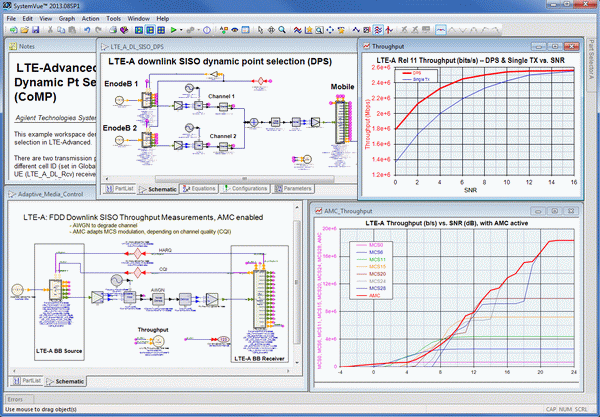
Agilent Technologies Inc. (NYSE: A) today announced that the Agilent EEsof EDA W1918 LTE-Advanced baseband verification library has added support for key 4G technologies, such as Adaptive Modulation and Coding (AMC) and Coordinated Multi-Point (CoMP).
The new modeling and simulation capability enables wireless system architects to model sophisticated dynamic behaviors and realistic performance at cell edges according to the physical layer (PHY) specifications of 3GPP Releases 10 and 11. This accelerates the design and verification process for 4G chipsets and infrastructure, enabling faster deployment.
The newly supported 4G technologies enable wireless infrastructure to tailor signals in marginal coverage areas to a particular mobile phone, using adaptive and cooperative techniques that go beyond simple 1:1 interaction between the transmitter and receiver. This dynamic behavior makes validation of the PHY algorithms, RF components and link-level throughput progressively more difficult in R&D-both in EDA simulations as well as test equipment-because negotiation and interaction are often required. That is, a complete working system is required to verify baseband algorithms, RF components and throughput under realistic conditions, making this process problematic in early R&D, prior to final hardware integration and test.
The SystemVue simulation environment, Agilent's premier platform for electronic system-level design, is able to reproduce these conditions in R&D with the help of the W1918 LTE-Advanced library. Updates to the W1918 library include:
AMC with active HARQ feedback, which re-configures the modulation and coding rates during simulation, varying the sample rates as needed, while maintaining the full RF accuracy of the physical layer models;
Dynamic Point Selection (DPS), a CoMP technique that enables multiple basestations to provide coordinated signals to a single mobile; and
Simulation support for PUCCH format 3.
"SystemVue stands alone as a development platform that can pull together sophisticated 'executable' standards references like LTE-Advanced Release 11, accurate RF models, wideband test equipment links, and open algorithm modeling interfaces such as MATLAB, C++ and HDL," said Frank Ditore, SystemVue product planner at Agilent. "As the industry moves toward 5G, all of these modeling domains are getting more difficult. Agilent is pleased to offer a platform that is truly ready today for 5G innovation."
SystemVue and its updated W1918 LTE-Advanced library will be shown at IMS 2014/IEEE MTT-S (Booth 1133), June 1-6 in Tampa, Florida, and at DAC 2014 (Booth 419), June 2-4 in San Francisco.
U.S. Pricing and Availability
Agilent's W1918 LTE-Advanced baseband verification library, part of SystemVue 2013.08 Service Pack 1, is available for download at www.agilent.com/find/eesof-systemvue-latest-downloads. This update to the W1918 library is expected in early June. Pricing for the SystemVue environment starts at approximately $17,687. A free, 30-day evaluation copy of SystemVue is available at www.agilent.com/find/eesof-systemvue-evaluation. |
|
|
|
|
|
主站蜘蛛池模板:
日韩午夜福利在线观看|
又黄又爽又色视频免费|
亚洲欧洲日产国产av无码|
韩国三级网址|
日本www一道久久久免费|
韩国av一区二区|
特级黄色视频|
色综合久久88色综合天天|
在线一区二区中文字幕|
国产欧美精品一区二区三区-老狼|
又黄又湿又爽的视频|
日韩二区视频一本6|
亚洲欧洲日产国产无码AV|
91豆花成人社区在线|
免费看成人欧美片爱潮app|
国产毛片三区二区一区|
欧美www在线观看|
人妻无码久久|
亚州AV成人无码久久精品|
2021久久最新国产精品|
精品国产一区二区三区大|
久久精品人人槡人妻人人玩av|
在线观看精品日本一区二
|
久久av一区二区三区|
高清无码二区|
久久亚洲国产最新网站|
亚洲国产精品嫩草影院久久|
欧美亚洲日本国产其他|
亚洲精品免费视频|
久久久久女人精品毛片|
日韩色色网|
久艾草在线精品视频在线观看|
40岁成熟女人牲交片20分钟|
亚洲欧美日韩高清一区二区三区|
日本无码中文|
久久精品网站免费观看|
巴塘县|
在线日韩日本国产亚洲|
欧美性爱自拍|
丰满老熟妇好大bbbbb|
亚洲粉嫩av一区二区黑人|